
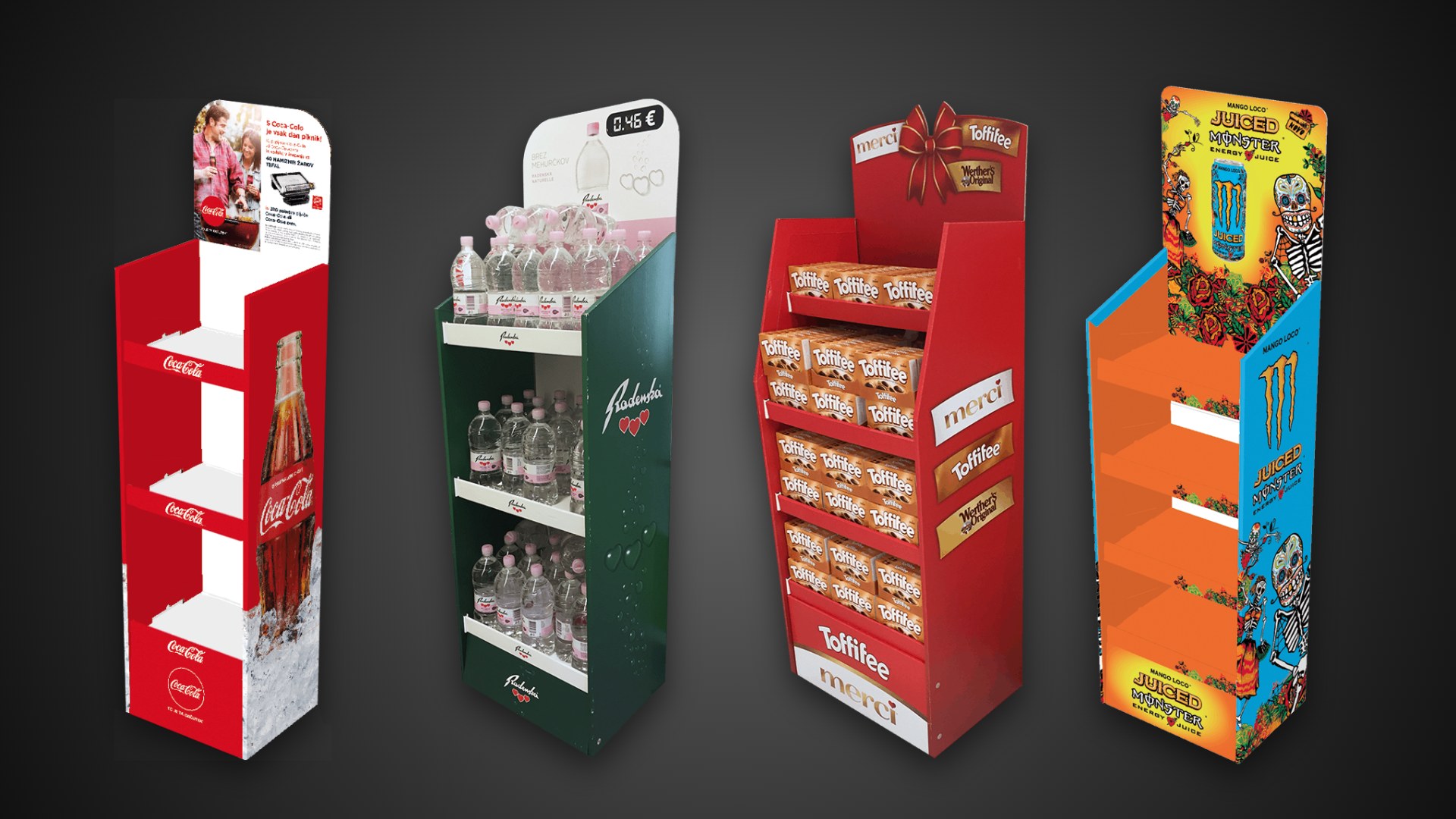
Floor displays are the most versatile type of retail display. They stand on their own on the shop floor, hold plenty of products and have enough room for graphics that stop shoppers from a distance. That makes them the first choice for new products, promotions and permanent presentations away from the regular shelf.
In this article we explain which types of floor displays exist, where they work best, what affects their load capacity and stability, and how to choose the right display for your product. You can see examples of floor displays we have made for our clients on our Floor displays page.
What are floor displays?
A floor display is a free-standing retail or promotional display placed on the shop floor. Other common terms are floor stands, free-standing displays, floor standing units and POS floor displays.
They differ from counter displays in size and placement, and from pallet displays in that they need no pallet and take up less space. A floor display can be placed almost anywhere in a store where there is enough room for shoppers and the display.
For smaller products on the sales counter or at the checkout, counter displays are the better choice.
Why choose a floor display
- The product is off the shelf. On the shelf a product is one of many. On a floor display it stands alone, with its own graphics and message.
- A large graphic surface. The header, side panels and shelf edges offer plenty of room for the logo, key visual and promotional message.
- Many products in one place. A floor display can hold a whole product line or several flavours and sizes, making the choice easier for shoppers.
- Placement in the best spots. At the entrance, at the end of an aisle or in front of the checkout, where most shoppers pass.
- Flexibility. We adapt the shape, size, number of shelves and graphics to the product and the space in the store.
Where to place floor displays
Floor displays work best in high-traffic spots:
- at the store entrance, where shoppers first look around,
- at aisle ends,
- in front of the checkouts, where shoppers queue,
- in the department where the product is normally shelved, as an extra reminder,
- in pharmacies, petrol stations and specialist shops,
- at trade fairs, exhibitions and events.
The location almost always has to be agreed with the store or retail chain, which often also sets the maximum display dimensions.
Types of floor displays
A floor display can be designed in almost any shape. The most common types are:
- Shelf displays for a larger number of packaged products. We describe what to look out for in detail in our article Cardboard shelf displays for a larger number of products.
- Hook displays for hanging products in bags or blister packs.
- Displays with compartments or slots, for example for bottles, cans or products that need to stand upright.
- Displays with a prominent header, where the focus is on a large graphic above the products that can be seen over the store shelves.
- Displays delivered pre-filled with products, which only need to be set up in the store. You can find more about these among our dump bins and sidekicks.
- Special-shape displays, for example in the shape of a product, a character or a vehicle, which we present among our impressive displays.
If you need even more room for stock and visibility from all sides, a pallet display is the better choice.
You can read more about the types, sizes and uses of pallet displays in our article Pallet displays: types, uses and how to choose the right one.
What are floor displays made of?
Most floor displays are made of cardboard. Cardboard is light and cost-effective, it can be printed over the whole surface, and the display is delivered flat or pre-assembled and set up quickly. That makes it ideal for promotions, launches and seasonal campaigns.
For floor displays that need to stay in the store for longer or carry very heavy products, metal, wood and plastic, as well as combinations of these, are also suitable. We compare the strengths and limitations of each material in our Guide to promotional displays.
Load capacity and stability of a floor display
A floor display has to carry the weight of the products and survive everyday life in a store. The key factors are:
- Weight and distribution of the products. A display for drinks is designed quite differently from one for snacks. Heavier products are best placed on the lower shelves.
- Shelf construction. Shelves glued to the back panel are more stable than loose shelves slotted into the back, and the display is quicker to set up.
- Reinforcements. Extra inserts in the side panels and plastic clips on the shelves increase load capacity and rigidity.
- Busy locations. Displays at checkouts and in narrow aisles are often hit by shopping trolleys, so they need to be sturdier.
That is why we always calculate the load capacity for a specific product, not for an “average” display.
Graphics on a floor display
A floor display has a large surface for graphics, but shoppers often see it for only a few seconds as they walk past. A few principles:
- The header can be seen from a distance and over the shelves, so the logo and main message belong there.
- One clear message: a new product, a promotion or the key product benefit.
- Shelf edges and side panels are a good place for extra information, flavours or the promotional price.
- Consistency with your corporate identity makes the display instantly recognisable as part of your brand.
- Graphics and construction together: cut-outs and folds determine which parts of the design remain visible.
At Modiz we can design the graphics for your display or use your ready-made artwork.
What to look out for when preparing artwork, and how we print displays, is covered in our article on display printing.
How a floor display is made
- Enquiry. You describe the product, the approximate quantity, the stores, the desired timing and your idea, if you already have one.
- Design and construction. We develop a construction that carries the required load and presents the products in a visually appealing way.
- Graphic design. We align the graphics with your brand.
- Printing and cutting. We print and cut the display, including unusual shapes.
- Delivery, installation and filling. On request we handle delivery of goods, installation at the point of sale and filling of the displays.
Among others, we have made floor displays for brands such as Coca-Cola, Radenska, Storck, Monster, Jolly, Gorenjka, Alpro and Delimano.
Frequently asked questions about floor displays
What is the difference between a floor display and a pallet display?
A floor display stands on its own on the floor and takes up less space. A pallet display is built on a pallet, holds far more stock and is often accessible from several sides. A floor display suits smaller promotions and permanent placements, while a pallet display suits large seasonal promotions.
How many products does a floor display hold?
That depends on the size and weight of the products and on the dimensions the store allows. We always design the display for a specific product, so the number of shelves and the spacing between them are adapted to your range.
How long does a cardboard floor display last?
A cardboard display is designed for the length of a promotion or campaign. Tell us in your enquiry how long it should stay in the store, as the construction and the choice of cardboard depend on it. For long-term placement, more durable materials are also suitable.
Is a floor display difficult to set up?
No. Well-designed floor displays are quick to set up because the shelves are glued to the back panel and do not need to be inserted separately. We can also handle the set-up for you.
Can you make a floor display for heavy products such as drinks?
Yes. For heavier products we reinforce the display, for example with inserts in the side panels and plastic clips on the shelves, and calculate the load capacity for your product.
Do you also take care of the graphics?
Yes. We can design the display graphics to match your brand or print your ready-made artwork.
Do you also deliver, install and fill the displays?
Yes. On request we take care of delivery, installation at the point of sale and filling the displays with products.
Conclusion
A floor display moves the product off the shelf to a place where shoppers notice it and gives it room to tell its own story. The right size, well-thought-out construction and clear graphics are what separate a display that sells from one that just stands there.
Take a look at examples of our floor displays or send us an enquiry and together we will design a floor display for your product.